
Software and Data Products
Software Products
A big part of our work consists of software development for cosmological simulations. You find the biggest projects along with a link to the source code repositories below.
The DISCO-DJ Ecosystem
One of our biggest ongoing efforts is the development of the DISCO-DJ (DIfferentiable Simulations for COsmology - Done with JAX) ecosystem. This ecosystem will eventually provide a fast, end-to-end autodifferentiable, and GPU-based pipeline for cosmological inference using highly exact non-linear simulation techniques. The already existing modules comprise
In addition, you might want to check out the fast JAX-based bispectrum calculator by our team member Thomas Floess
Multi Scale Initial Conditions – the MUSIC code for zoom simulations
MUSIC is an initial-conditions generator for zoom simulations, where high resolution is generated only in a small subregion of space. MUSIC supports virtually all commonly used simulation codes in numerical cosmology.
- MUSIC v2 code repository
- access the MUSIC1 code repository for legacy compatibility
High Precision Initial Conditions – the monofonIC code for highly accurate simulations
monofonIC is the full-grid (non-zoom) initial conditions generator part of MUSIC2. It currently supports very high order Lagrangian perturbation theory, as well as a significantly more accurate treatment of multi-fluid initial conditions. In contrast to MUSIC1, it also can run on many nodes using MPI.
Data Products
Below you find some of our data products.
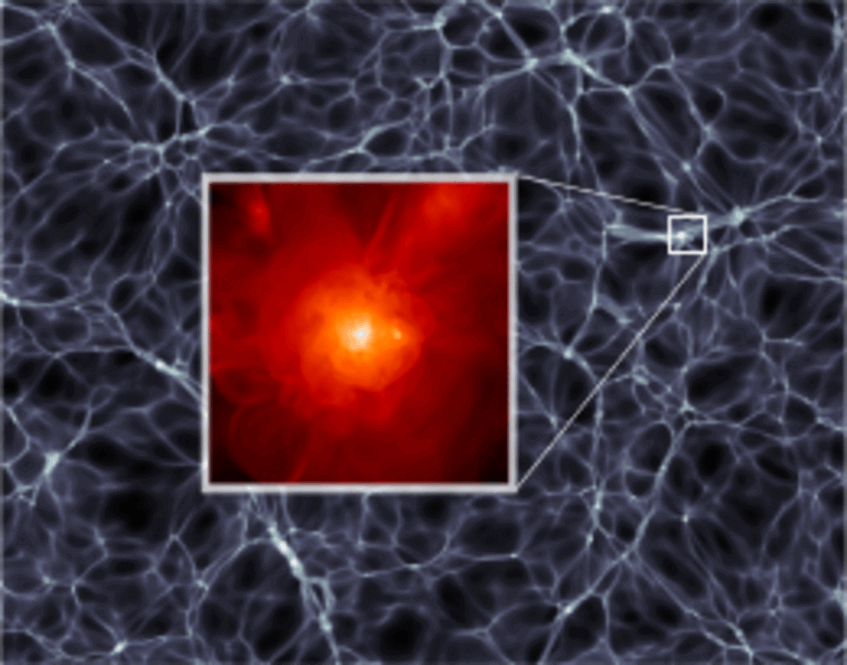
cosmICweb -- the virtual universe!
CosmICweb is a database system for initial conditions for cosmological zoom simulations built around the MUSIC cosmological initial conditions generator infrastructure.
Click here to access the cosmICweb website.
DASH -- a library of dynamical subhalo evolution
DASH is a library that contains thousands of N-body simulations following the dynamical evolution of a dark matter subhalo in a host halo potential as described in Ogiya et al. 2019.
The DASH library is freely accessible and comes with a Python notebook that implements a pre-trained (machine learned) model of the data.